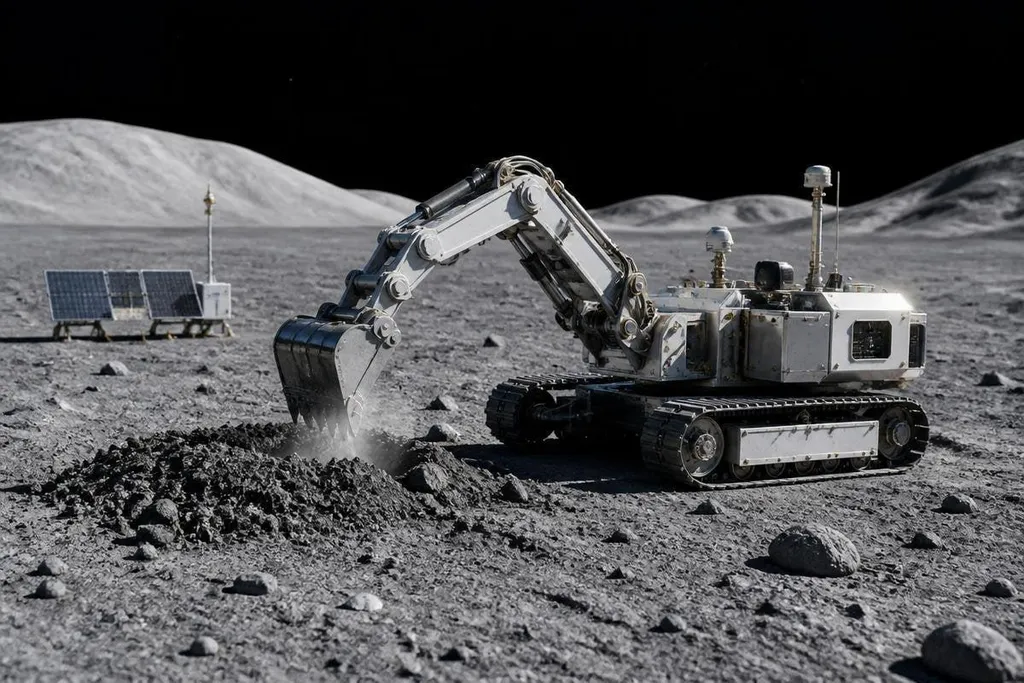
A space mining robot may spend its first working day moving dust, not collecting valuable metal. The early targets are likely to be lunar water ice, oxygen in Moon soil, and materials that can support machines far from Earth.
Quick read
- Lunar water could supply drinking water, oxygen, and rocket fuel
- Robots must work through vacuum, low gravity, radiation, and abrasive dust
- The first useful mine may support another robot rather than ship material home
What robots would mine first
Water is the most useful early target because one deposit can support several tasks. A robot could heat ice, collect the vapor, and split the water into hydrogen and oxygen. The hydrogen could fuel a rocket, while the oxygen could support breathing or make up most of the propellant by mass.
Lunar soil, called regolith, offers another source of material. It contains oxygen bound to minerals, along with silicon, iron, aluminum, and calcium. Extracting those elements needs heat or electrical processing, so a mine would need a steady power source and machines that can survive long work cycles.
Before working on an asteroid, the machine must find a suitable body, match its motion, attach to a surface that may have little gravity, and move material without sending it drifting away. Returning metal to Earth would add another hard problem: the material needs a safe return path and a buyer willing to pay for the full mission.
How the machines would work
A mining system would need more than a drill. It would need cameras and other sensors to map the ground, a digging tool that can handle loose soil, and a way to hold material while the robot moves it. The machine might also need a small hopper, a heater, and a processor that separates useful material from waste.
Low gravity makes digging harder. On Earth, a heavy vehicle can push a bucket into soil because its weight holds it down. On the Moon, the same push could lift the machine instead. A robot may need a wide base, anchors, a counter-rotating drill, or a tether fixed to the ground.
Dust creates a second problem. Lunar regolith can scratch surfaces, enter seals, cover cameras, and cling to equipment through static charge. A working system would need dust covers, protected joints, cleaning tools, and a way to check wear before a small fault stops the whole site.
The machines would also work with delays in communication. A controller on Earth can send a task, but it can't guide every wheel turn in real time. The robot must detect a blocked tool, a tilted vehicle, or a loss of grip, then pause or choose a safe response on its own.
That independence makes the evidence harder to judge. A report needs to name the robot and show what it did when the task changed. Reports on space mining robots can put those details beside the machine’s power needs before the next section.
Power sets the work schedule
A mine needs power for movement, digging, heating, communication, and material processing. Solar panels may work well in some areas, yet darkness can last for long periods on the Moon. A system near a polar ridge may receive more sunlight than one in a shadowed crater, but the robot still has to travel between power, work, and storage sites.
That layout shapes the whole design. A small rover may collect samples, while a larger platform stays near the processing equipment. If the machines must drive several kilometers to reach a deposit, the time spent moving can matter as much as the digging rate.
The first useful output may stay in space. Water stored near a lunar worksite could support later missions, reduce the amount launched from Earth, and give robots a local supply for cooling or protection. Shipping refined metal home is a much harder business case, especially when the mine must first pay for launch, landing, power, repairs, and control.
What remains unproven
No commercial space mine has yet shown steady production under lunar or asteroid conditions. A short test can show that a drill cuts soil; it can't prove that the drill will work after months of dust, cold, radiation, and repeated loads.
The unknowns include deposit size, material quality, repair methods, machine life, and the cost of moving the output. A robot that finds ice still needs to reach it, extract it, clean it, store it, and keep the system warm enough to work.
I'd wait for a mission to show repeated digging and material handling before treating space mining as a working industry.
A practical test for new claims
Use these checks when a company or agency presents a space mining plan:
- Name the material. Ask whether the target is water ice, oxygen in regolith, metal, or a sample for later study.
- Check the tool. Look for a named drill, bucket, scoop, heater, or separator and the ground test behind it.
- Measure the output. Find the planned kilograms per day, power draw, storage volume, and work period.
- Follow the route. Track each step: ground collection, transfer into a hopper, processing, storage in a tank, loading into a vehicle, or return.
- Find the failure plan. Ask what the robot does after a jam, dust buildup, wheel slip, sensor fault, or lost signal.
The next serious milestone is a robot that repeats the full chain: reach a deposit, collect material, process it, and store a measured amount. Until that happens away from Earth, space mining remains a set of hard engineering plans rather than a supply system.